Hydraulic sizing
Static head, friction loss, drawdown and daily water requirement define the duty point.
Solar Water Pumping
A solar water pumping system runs a surface or submersible pump directly from solar modules through a pump controller, delivering water during daylight hours without diesel or grid supply.
A solar water pumping system runs a surface or submersible pump directly from solar modules through a pump controller, delivering water during daylight hours without diesel or grid supply.
Solar pumping is sized on hydraulics, not on roof area: total dynamic head, required daily water volume, borewell or source characteristics and the delivery point determine pump and array size.
GLS supplies and installs solar pumping systems with array mounting, controller, cabling, protection and dry-run safeguards, along with commissioning and performance checks.
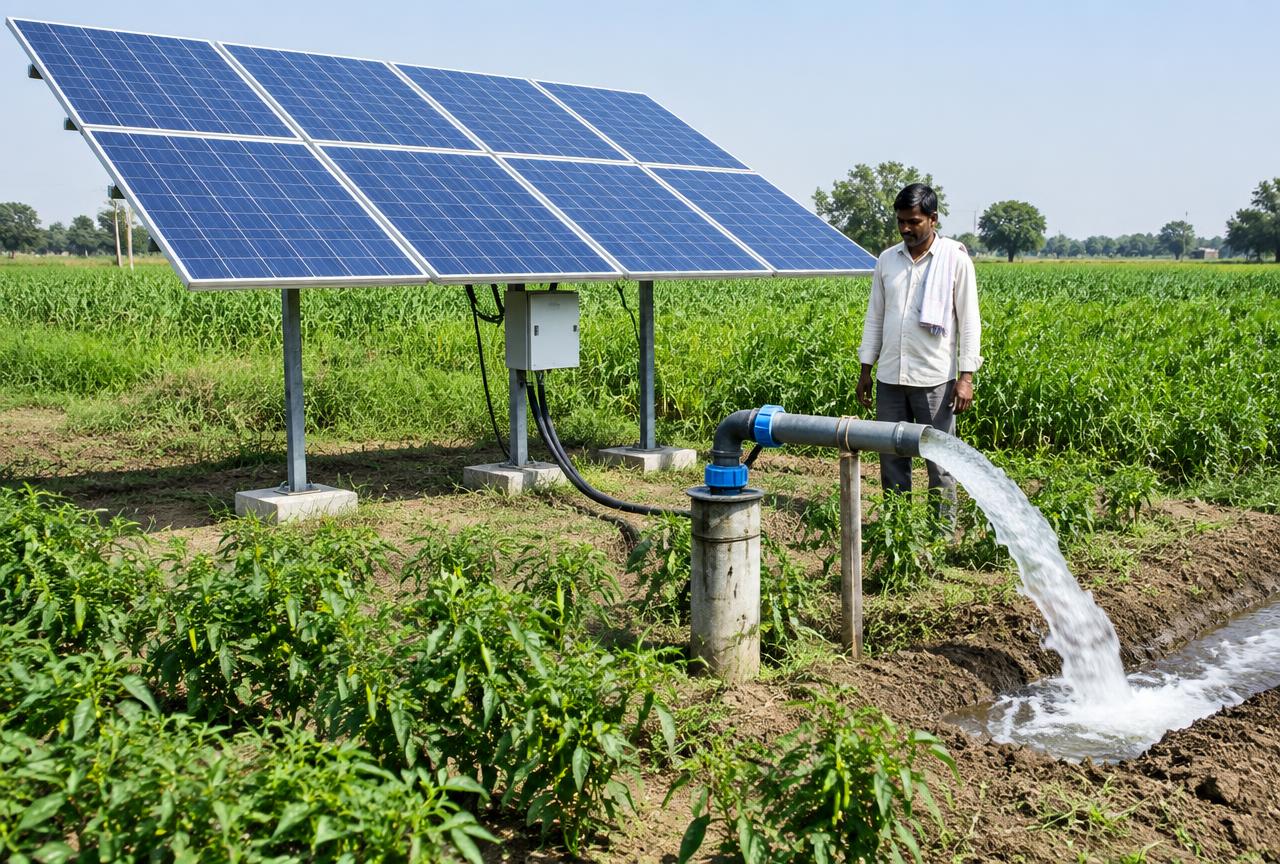
Static head, friction loss, drawdown and daily water requirement define the duty point.
AC pump with VFD controller or DC pump, selected for the duty point and source depth.
Module array sized to run the pump across the usable solar day on a fixed or seasonally adjustable structure.
Dry-run protection, overload and surge protection, and proper earthing for pump and array.
We understand your load profile, electricity bill, tariff category and objective.
Roof or land survey covering area, orientation, shadow, structure and electrical infrastructure.
Capacity sizing, layout, module and inverter selection, cable and protection design.
Detailed scope, bill of materials, indicative generation and commercial proposal.
Structure fabrication and erection, module mounting, DC and AC works, earthing and protection.
Insulation, polarity, string current, earthing and inverter commissioning checks.
Coordination for net-metering or grid approval where applicable, then documented handover.
Generation review, scheduled cleaning and inspection, and corrective maintenance.
Pump sets powered directly by solar modules through a controller, for irrigation and water supply without diesel or grid power.
Photovoltaic modules that convert sunlight into DC electricity — the generating element of every solar system.
The structure holds modules at the designed tilt and orientation and transfers wind and dead loads safely into the roof or ground.
GLS has completed 300+ projects across Tamil Nadu. Case studies in this category are being documented with client approval, and we publish only what owners have confirmed may be shared. Ask us for references relevant to your category and we will send what has been approved for disclosure.
Projects & Case StudiesIt will run at reduced output when irradiance is low and may stop in heavy cloud. Where supply must be continuous, systems are designed with storage tanks sized for such days.
Usually not. Most systems pump directly into a tank during the day, which is cheaper and simpler than storing electricity in batteries.
A short conversation about your consumption and site is usually enough for us to tell you what is worth doing.