Day charging
The module charges the battery through a controller, with charge and load protection.
Solar Street Lighting
Solar street lights are standalone units in which a panel charges a battery during the day to run an LED luminaire at night, with no cabling back to a grid supply point.
Solar street lights are standalone units in which a panel charges a battery during the day to run an LED luminaire at night, with no cabling back to a grid supply point.
Each pole is self-contained: module, battery, controller and LED luminaire. That removes trenching, underground cabling and metered consumption, which is often why solar lighting is chosen for new layouts, campuses and perimeter roads.
GLS supplies and installs integrated and semi-integrated solar lighting with foundation work, pole erection, commissioning and optional maintenance.
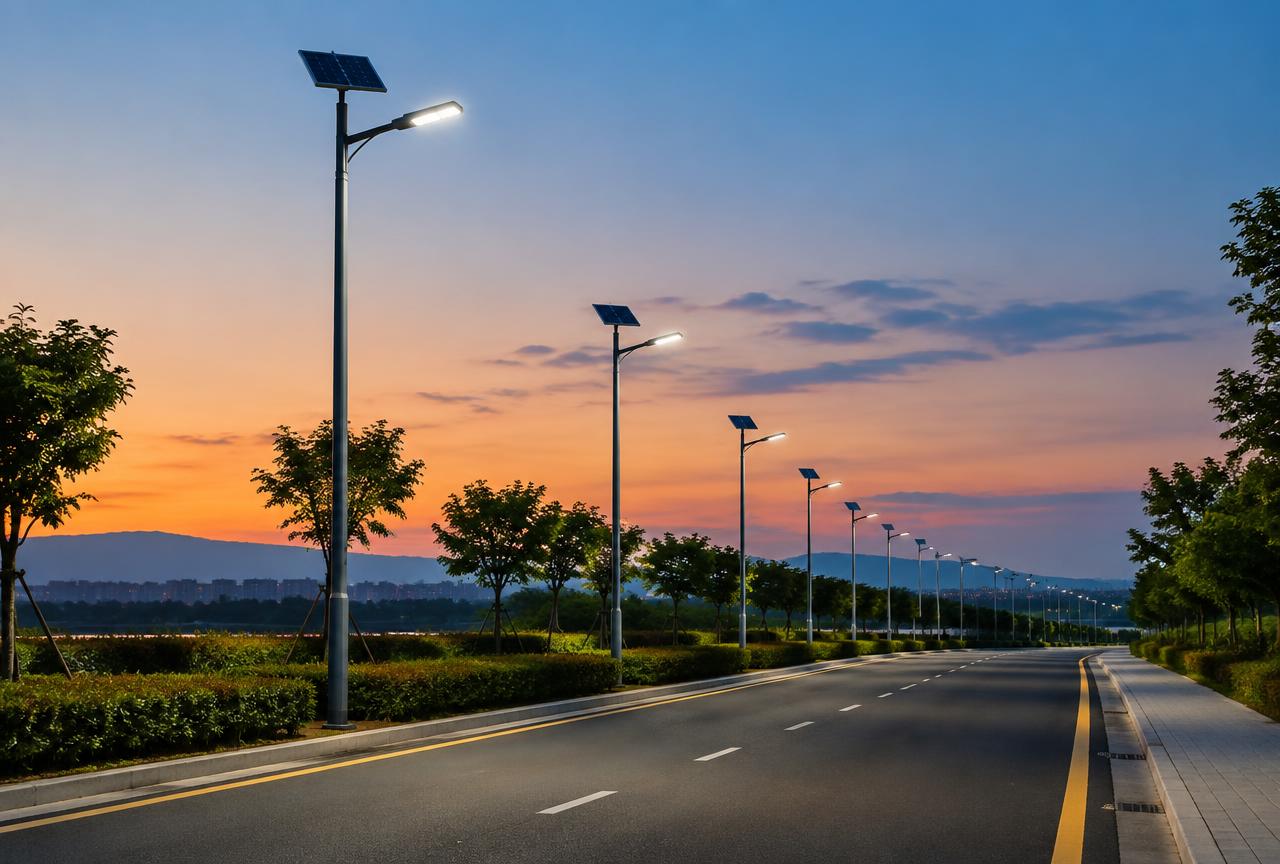
The module charges the battery through a controller, with charge and load protection.
The LED driver runs the luminaire on dusk-to-dawn or timed profiles, often with dimming to extend autonomy.
Battery capacity is sized to carry the lighting through the night and over one or more low-sun days.
Foundation, pole, mounting bracket, panel orientation and anti-theft fastening at each location.
We understand your load profile, electricity bill, tariff category and objective.
Roof or land survey covering area, orientation, shadow, structure and electrical infrastructure.
Capacity sizing, layout, module and inverter selection, cable and protection design.
Detailed scope, bill of materials, indicative generation and commercial proposal.
Structure fabrication and erection, module mounting, DC and AC works, earthing and protection.
Insulation, polarity, string current, earthing and inverter commissioning checks.
Coordination for net-metering or grid approval where applicable, then documented handover.
Generation review, scheduled cleaning and inspection, and corrective maintenance.
Self-contained lighting units that charge by day and illuminate by night without grid cabling.
Batteries store solar energy so selected loads can run when there is no generation or no grid.
Photovoltaic modules that convert sunlight into DC electricity — the generating element of every solar system.
GLS has completed 300+ projects across Tamil Nadu. Case studies in this category are being documented with client approval, and we publish only what owners have confirmed may be shared. Ask us for references relevant to your category and we will send what has been approved for disclosure.
Projects & Case StudiesTypically dusk to dawn when the system is sized for it, often with dimming after peak hours. Actual runtime depends on battery capacity, luminaire wattage and recent sunlight.
Spacing follows the lighting design — luminaire output, pole height, road width and the illuminance level required. We work this out for your layout rather than applying a fixed distance.
A short conversation about your consumption and site is usually enough for us to tell you what is worth doing.