Load and tariff study
We review consumption pattern, tariff category, demand profile and sanctioned load to size capacity sensibly.
Commercial & Industrial Solar
Commercial and industrial solar reduces the cost of day-time electricity for businesses by generating power at the point of consumption. GLS engineers and executes these systems on factory, warehouse, institutional and commercial buildings.
Commercial and industrial solar reduces the cost of day-time electricity for businesses by generating power at the point of consumption. GLS engineers and executes these systems on factory, warehouse, institutional and commercial buildings.
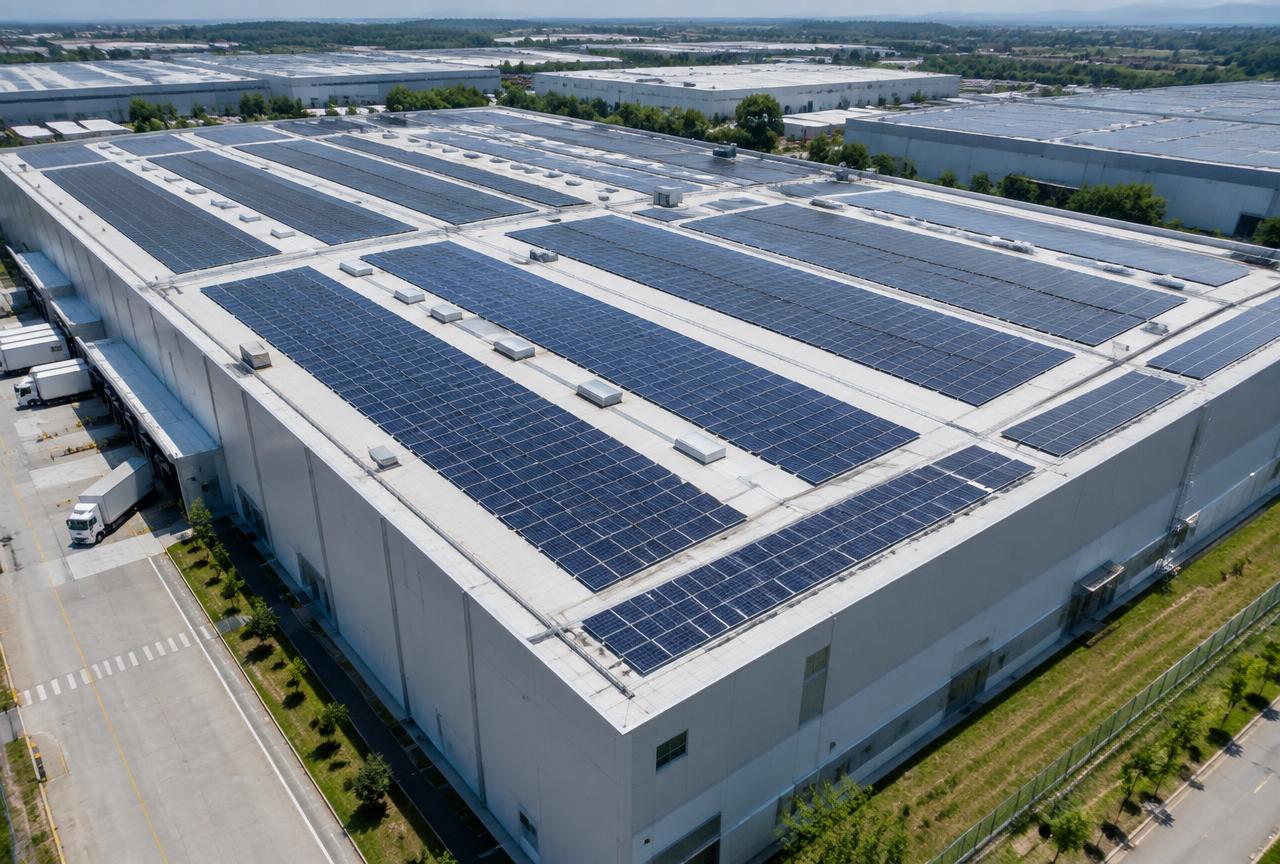
For a commercial or industrial consumer, the value of solar comes from displacing high-tariff day-time units with on-site generation. Because these systems are larger, the engineering matters more: structural capacity, cable routing, protection coordination, HT/LT interface and safe working at height all have to be planned before execution starts.
GLS takes projects from feasibility and single-line diagrams through procurement, civil and structural works, DC and AC installation, testing and commissioning, and into a maintenance regime that keeps generation close to design.
We review consumption pattern, tariff category, demand profile and sanctioned load to size capacity sensibly.
Roof sheeting, purlin spacing and structural capacity decide whether rail-based, standing-seam or elevated structures are used.
Inverter grouping, AC combiner panels, protection and metering interface are designed for your existing distribution.
Work is sequenced around plant operations with defined safety practice for work at height and live electrical work.
We understand your load profile, electricity bill, tariff category and objective.
Roof or land survey covering area, orientation, shadow, structure and electrical infrastructure.
Capacity sizing, layout, module and inverter selection, cable and protection design.
Detailed scope, bill of materials, indicative generation and commercial proposal.
Structure fabrication and erection, module mounting, DC and AC works, earthing and protection.
Insulation, polarity, string current, earthing and inverter commissioning checks.
Coordination for net-metering or grid approval where applicable, then documented handover.
Generation review, scheduled cleaning and inspection, and corrective maintenance.
Photovoltaic modules that convert sunlight into DC electricity — the generating element of every solar system.
The inverter converts DC from the array into usable AC power and controls how the system interacts with the grid and batteries.
The structure holds modules at the designed tilt and orientation and transfers wind and dead loads safely into the roof or ground.
Switching, protection and metering enclosures that make a solar plant safe to operate and maintain.
GLS has completed 300+ projects across Tamil Nadu. Case studies in this category are being documented with client approval, and we publish only what owners have confirmed may be shared. Ask us for references relevant to your category and we will send what has been approved for disclosure.
Projects & Case StudiesNo. Most commercial systems are sized to the day-time base load so that generation is self-consumed. Oversizing beyond what the site consumes or can export rarely improves the economics.
Yes, with mounting hardware chosen for the sheet profile and purlin structure. A structural and sheet condition check is part of the assessment before any design is finalised.
Work is planned in zones and scheduled around your shifts. Shutdowns are limited to the specific activities that require them, and are agreed in advance.
A short conversation about your consumption and site is usually enough for us to tell you what is worth doing.