Generation
Modules produce DC power whenever there is usable irradiance; output varies with sunlight, temperature, shading and soiling.
Solar Rooftop Solutions
Rooftop solar converts sunlight falling on your roof into electricity that your building uses first, reducing the units you draw from the grid. GLS designs, installs, commissions and maintains rooftop systems in Chennai and across Tamil Nadu.
Rooftop solar converts sunlight falling on your roof into electricity that your building uses first, reducing the units you draw from the grid. GLS designs, installs, commissions and maintains rooftop systems in Chennai and across Tamil Nadu.
A rooftop solar system generates direct current from photovoltaic modules, which an inverter converts to alternating current at your building's voltage. The output is consumed by your loads first; the balance is either exported to the grid or stored in batteries, depending on the system type.
GLS handles the full scope: structural and shadow assessment, capacity sizing against your consumption, module and inverter selection, mounting structure design, DC and AC works, earthing and lightning protection, commissioning and documentation.
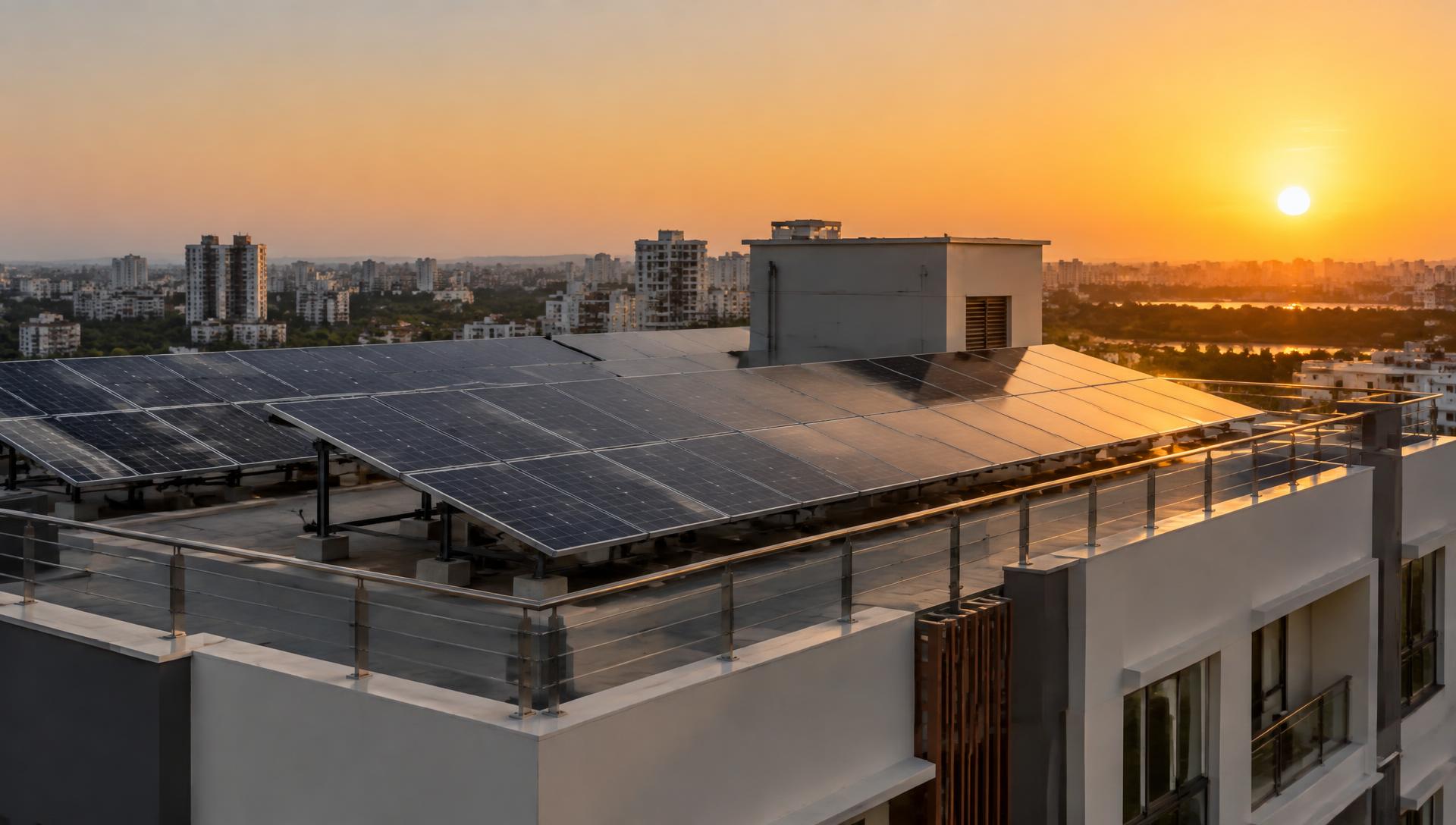
Modules produce DC power whenever there is usable irradiance; output varies with sunlight, temperature, shading and soiling.
A string or hybrid inverter converts DC to AC and synchronises with your internal distribution board.
Your loads use solar output first, so the meter records fewer imported units during generating hours.
Surplus is exported under net metering on an on-grid system, or charged into batteries on an off-grid or hybrid system.
We understand your load profile, electricity bill, tariff category and objective.
Roof or land survey covering area, orientation, shadow, structure and electrical infrastructure.
Capacity sizing, layout, module and inverter selection, cable and protection design.
Detailed scope, bill of materials, indicative generation and commercial proposal.
Structure fabrication and erection, module mounting, DC and AC works, earthing and protection.
Insulation, polarity, string current, earthing and inverter commissioning checks.
Coordination for net-metering or grid approval where applicable, then documented handover.
Generation review, scheduled cleaning and inspection, and corrective maintenance.
Photovoltaic modules that convert sunlight into DC electricity — the generating element of every solar system.
The inverter converts DC from the array into usable AC power and controls how the system interacts with the grid and batteries.
The structure holds modules at the designed tilt and orientation and transfers wind and dead loads safely into the roof or ground.
Balance of system covers everything between the modules and the supply point — where quality quietly decides long-term safety and losses.
GLS has completed 300+ projects across Tamil Nadu. Case studies in this category are being documented with client approval, and we publish only what owners have confirmed may be shared. Ask us for references relevant to your category and we will send what has been approved for disclosure.
Projects & Case StudiesPlan for roughly 65–100 sq ft of shade-free area per kW. The exact figure depends on module wattage, tilt and the clearance required for cleaning and airflow. A site assessment confirms what your roof can hold.
A standard on-grid system shuts down during a grid outage for safety. If you need power during outages, you need a hybrid or off-grid system with battery storage, which GLS can design instead.
Timelines depend on system size, roof condition, material availability and utility approvals. GLS confirms a schedule in the proposal after the site assessment rather than quoting a standard duration.
A short conversation about your consumption and site is usually enough for us to tell you what is worth doing.